

Ten Pillars of Regenerative Practice

Ten Pillars of Regenerative Practice





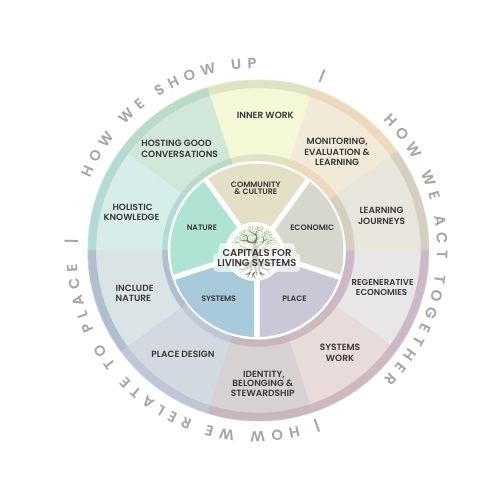


These pillars are not a checklist.
They are dimensions of living practice.
These Ten Pillars are dimensions of practice, and genuine regenerative work requires attending to all of them. That means developing competency across the whole, not just optimising and working on one pillar. A good practitioner will pay attention to the ripple effect across different pillars and see interdependencies.
Regeneration is not a marketing term or a new overlay on old sustainability thinking. It is a different set of priorities that balances what is good for business with what is good for place and its social, economic and ecological systems. We cannot grow a business if our ecosystems are in decline.
These pillars emerged from thirty years of embedded practice, not from observing others and building a framework around it. They exist to help practitioners, policymakers and communities distinguish genuine regenerative work from greenwashing, and are grounded in the recognition that places are complex, adaptive living systems, not products to be optimised.
How we use these pillars
Regenerative practice is systems work. In a living system, every part affects every other part — you cannot fix the ecology without attending to the community, cannot strengthen the community without attending to governance, cannot change governance without shifting the economic relationships that lock-in the current model.
These pillars are also never finished. You cannot check them off the list. Like the places they attend to, they are always in process: emergent, responsive, and shaped by what the work reveals.
What this means in practice is that we do not offer a program that runs from A to B. We offer sustained engagement with the questions that matter, in the places where they arise, with the people who have to live with the answers.
A Note on Scale
In the dominant model, scale means adoption: how many organisations have implemented the framework, how many downloads, how many certified practitioners. That model treats knowledge as a product to be distributed and success as a number. It's business-as-usual where the motivation is to sell the product. Any ecological improvement is a secondary outcome.
In living systems work, scale moves differently. It moves through learning and connection, and through the practitioner who works and learns with a community, say on Flinders Island, and takes something back to their own context and applies it, that's scaling. Through the conversations at annual gatherings that shifts how someone thinks about their work, through the slow evolution of practice as people apply ideas in real conditions and discover what holds and what does not, that's scaling at the pace of place.
This kind of scale cannot be counted, but it changes things more durably than any framework or checklist ever could. It also relies on human connection, listening, and collaboration, which build resilience and local 'know-how'. This kind of scaling removes reliance on fickle, short-term funding cycles because the knowledge and practice generated rests with people in place, not consultants with access to funding who move on and take the funding with them.

The Islander Way — Flinders Island, Tasmania
A multi-year community-led regenerative tourism living lab on Flinders Island. The project asked: how might tourism contribute to a flourishing community, place, and environment? The result was a regenerative hosting framework adopted by the local council.

Gulf Savannah — Remote Queensland
Working with operators and communities in another of Australia's most remote and ecologically distinctive landscapes to tell their stories of floods, economic and social resilience through genuine connection to community and Country.


Local 2030 Islands Network — Global Scaling
A global network scaling regenerative thinking across island communities — celebrating island knowledge systems, Indigenous wisdom, and islands as leaders of genuinely different development models. Hawaii became the first jurisdiction to pass a regenerative development bill.

Up the Creek — Naam/Melbourne
Read the case study
A regenerative business coaching case study. Up the Creek is a nature-based river experience founded on a different way to grow: by letting go of extraction-minded business logic and learning to work with the river as a partner, not a setting. Transformation unfolded.
Projects and Case Studies
These are not hypothetical examples or curated best practices sourced from elsewhere. They are projects we have been part of, and in some cases led. In other cases, we contributed to, over years and in real conditions. The work was difficult, non-linear, and occasionally uncomfortable. That is what genuine systems change looks like.
Each case study or work is linked to the Ten Pillars of Regenerative Tourism framework and documents not just what happened, but what we learned about how change actually moves through places and communities.
Our Story
Related Insights
-
Responsible vs Regenerative: Why the Distinction Matters
-
Incorporating Living Systems Thinking in Place Planning
-
Greenwashing, Co-optation and the Limits of Certification
-
When the World Order Shifts, Can Tourism Stay the Same?
Citing the 10 Pillars
Dredge, D. (2021). The Ten Pillars of Regenerative Tourism. Place Ecologies / The Tourism CoLab. Updated 2026.
Retrieved from placeecologies.com/regenerative-tourism-framework